A
Role commitment
Participants lock HMX to take on public responsibilities — and are held accountable for violations that are predefined and verifiable. Locking never replaces qualifications, independence or track record.
HMX Token Whitepaper · 2026
An open collaboration network for humanoid robots.
Connecting real-world tasks, trusted payments, authorized data, and joint development under shared rules.
One loop. Six steps.
Value stays in the network.
01 — The protocol loop
Every engagement follows the same path — from a written task to a reusable capability. Nothing moves forward until the previous step is proven.
Scope of work, price, timelines, acceptance criteria, AI intervention rules and dispute procedures are fixed in a versioned contract.
Operators run the job on site and submit quantities, exceptions and attachments as evidence.
Independent reviewers check deliverables against the accepted scope. Partial acceptance and appeals are first-class outcomes.
Payment clears in fiat, stablecoin or enterprise finance — with fees, refunds and reconciliation on the record.
With explicit consent, data and tooling from the job can enter the public program under defined rights.
Templates, adapters and standards from one delivery lower the cost and effort of the next.
Safety stays off the chain. Robots, real-time control and safety systems operate independently. A blockchain disruption must never cause an emergency stop or require on-site intervention.
02 — Why a token
A
Participants lock HMX to take on public responsibilities — and are held accountable for violations that are predefined and verifiable. Locking never replaces qualifications, independence or track record.
B
A capped supply and a results-based budget fund the things every operator needs: public data, adapters, evaluation frameworks and standards. Rewards follow verified results, not upload volume.
C
Participants decide on public budgets, protocol standards and key network parameters — inside a clearly defined scope of delegated authority.
A single robot order can cover equipment and on-site services. It rarely funds the adapters, datasets and standards that every operator depends on. HMX lets many independent entities co-own that shared layer — as payment, staking and security deposits, not as a claim on customer funds.
03 — Why HMX
An adapter can serve several operators. One evaluation toolkit can support many customers. Good data can serve many development teams.
When the benefit is shared, the cost should not sit with one participant. HumanX turns public deliverables into a shared budget, a verification process and a contribution incentive.
A verifier's obligations are defined in advance, and so are the consequences.
Payment is tied to outcomes that are used, reused and maintained.
Proposals, objections and final decisions are disclosed.
Rights are not trapped. Exits have waiting periods and unresolved cases are handled.
04 — Architecture
Each module owns one question: what was agreed, who did it, what proves it, who accepts it, how it settles, and how the protocol records it.
Scope of services, pricing, timelines, acceptance criteria, AI intervention rules and dispute procedures. Material changes require a new contract version.
Versioned contractsSeparates equipment, operators, authorizations and signing credentials. Supports switching, revocation and recovery.
Roles & keysLinks task versions, execution events, quantities, exceptions, AI intervention, customer acceptance and attachment integrity.
Tamper evidenceHandles full and partial acceptance, additional evidence and disputes. Decisions and appeal channels are retained.
Acceptance recordsReconciles contracts, fees, refunds and actual payments across fiat, stablecoin and enterprise finance.
Fiat + on-chainHMX distribution, vesting and release, role binding, public budgets and governance processes — the layer that makes the network self-maintaining.
HMX lifecycleAn integrity proof can show a record was not altered. It cannot independently prove a physical event happened. HumanX says so, and keeps human verification in the loop.
Raw video, customer contracts, detailed logs and personal data stay off-chain in a trusted environment. Only necessary records are written on-chain, after a privacy assessment.
05 — The flywheel
A job that is done well produces more than a payment. It produces authorized experience, better tools, and a cheaper next job.
Data workflow
Commercial revenue from data licensing goes to the party holding the agreed rights. Joining a task does not grant consent to train models on its data.
06 — Tokenomics
HMX has a fixed maximum supply. It is minted once, allocated to the treasury and a release contract, and never increased.
Cross-network bridging does not increase total supply and follows lock or burn mechanisms.
Data, tools, standards and infrastructure maintenance
Approved public network operations and reserves
Long-term development and ongoing services
Capital injected against actual funding, with a clear vesting schedule
Limited, real participation and community programs
Liquidity deployed at launch
Dedicated projects executed on results
Task payments are not automatically converted into token purchases. Public rewards are not counted as the customer's revenue. Equity returns and the protocol treasury are accounted for separately.
Protocol service fees are specified by public rules, published in advance, and cannot be raised retroactively through governance.
07 — Use cases
01
For verifiers and public roles
HMX locking applies to specific roles in public verification and ledger maintenance. Admission still depends on professional qualifications, independence, real service capability and history — a lock does not replace any of them.
Penalties apply only to predefined, verifiable violations. Ordinary failures and reasonable judgment calls are not misconduct. Customer loss protection comes from contracts, deposits and insurance — the token is not the sole source of compensation.
02
For builders of shared capability
Public programs prioritize the things that compound: reusable adapters, task and evidence standards, authorized datasets with clear uses, independent testing tools, and maintenance of public infrastructure.
Rewards are released in phases, with verification and monitoring in place. Disbursed cash, tokens and unvested amounts are tracked separately.
03
For people who maintain the network
Governance covers public budgets, standard versions, partial role rules and authorized network parameters — and nothing else.
Tokens do not grant the right to:
08 — Governance
Governance is handed over in three phases. Each phase is earned by operating results, not by announcing a roadmap.
The core team leads under product and customer contracts. Allocations, permissions, budgets and major changes are disclosed publicly.
The network is not described as fully decentralized before it is.
Clients, operators, developers and verification institutions set standards and validate public projects together. Conflicts of interest are disclosed.
No party may independently verify its own payments.
Clearly defined items move on-chain: public budgets, standard versions and designated parameters.
Major changes carry a recommended execution delay of at least 7 days.
Decision path
Supporting and opposing opinions are published alongside every final decision — to prevent opaque controllers forming quietly. Treasury spending supports approved public goods; it is not distributed equally among holders.
09 — Roadmap
No phase starts because the previous one launched. It starts because the previous one passed its acceptance criteria.
Contract templates, customer onboarding, pilot payment setup.
Tasks, evidence, acceptance and settlement in one flow.
Adapters, standard versions and comparable operational records.
Dataset or tooling projects with independent verification.
Locked templates, dispute resolution and an exit drill.
Issuance materials, contracts, release and governance setup.
Public budget and transfer of standardized authority.
10 — Disclosure
Device registrations, wallet balances and transaction volume alone do not prove a network works. These are the numbers HumanX commits to publishing.
Paying clients, contract value, platform revenue, direct payment costs, client implementation costs.
Task acceptance rate, dispute rate, settlement time, manual intervention rate, cost of repeated integration.
Verified public outputs, independently adopted use cases, maintenance sustainability, real use of authorized data.
Identified service providers, governance participation, treasury spending, reward distributions, future unlock plans.
Revenue share of top clients, portion of related-party transactions, share of clients verified by leading institutions, balance retained after subsidies and exits.
Definitions, calculation methods, counting scope and sampling constraints are disclosed alongside the numbers.
11 — Risks
Every network has failure modes. Writing them down is the first mitigation.
12 — Participate
Participation opens progressively, based on product maturity and actual business needs — not on a countdown.
Propose real-world tasks; help set payment pilots and acceptance standards.
Onboard devices and services; validate cross-scenario payment workflows.
Build certified adapters; take part in compatibility and version maintenance.
Contribute open tools, interfaces and sample projects.
Join clearly defined, properly authorized data projects for specific uses.
Take part in independent reviews, conflict management and dispute procedures.
Supervise and govern the public budget according to the rules.
13 — In one breath
Turn real work
into real revenue.
Let qualified contributions
compound into capability.
Enable collaboration
through shared rules.
HumanX — building the future of open collaboration for robot services.
14 — The document
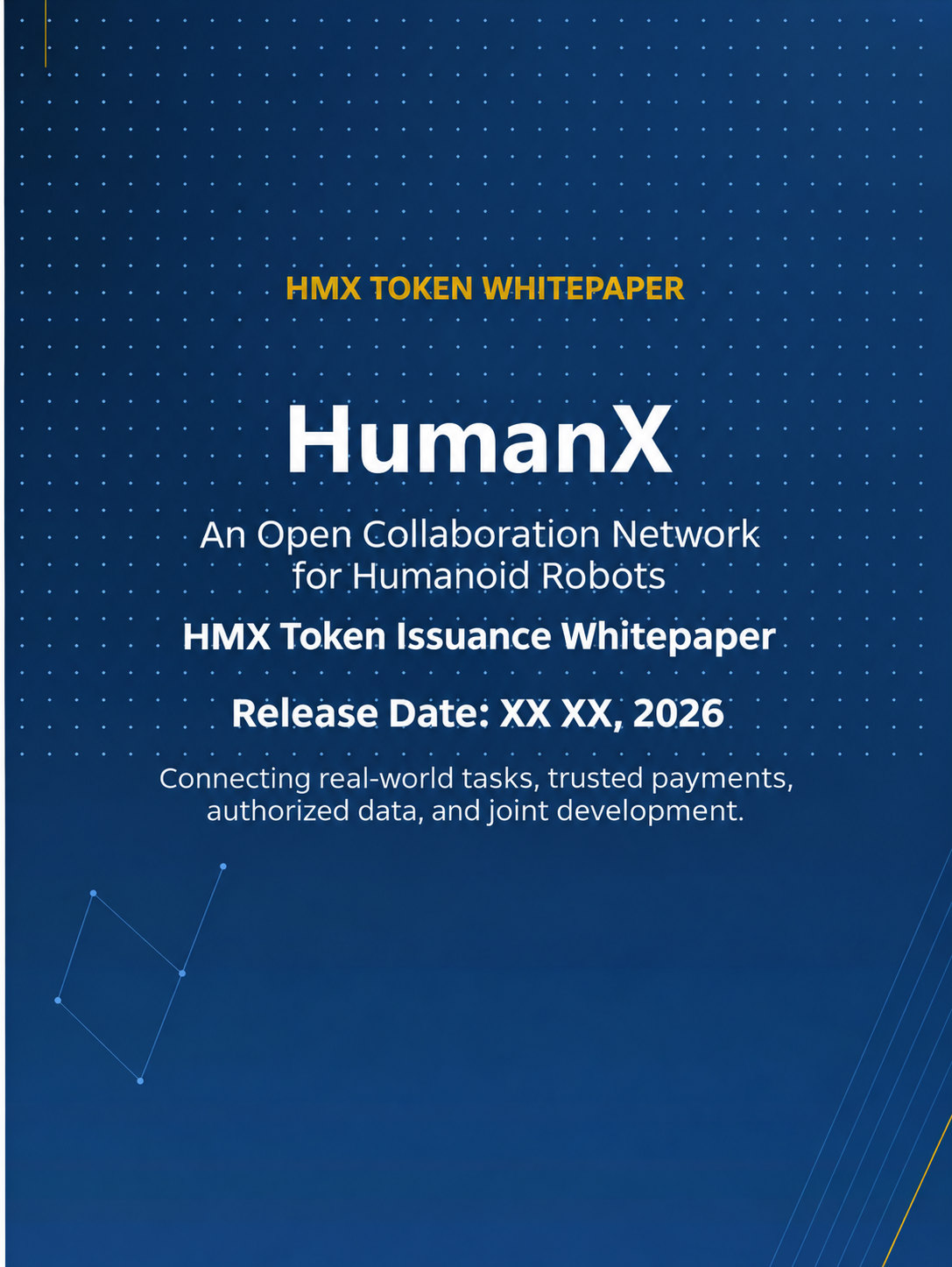
The whitepaper covers the network model, six modules, token supply and allocation, three governance phases, the implementation roadmap and the risk register — in 28 pages, no marketing filler.